
Roach.
Rutilus rutilus. 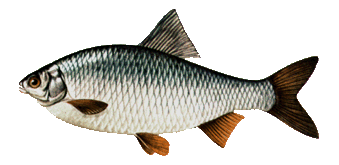
Family Cyprinidae
Distribution: Common in England, central Scotland, parts of Wales and Ireland.
Habitat:
A very common fish found in most lowland lakes, ponds, rivers and canals.
Description: A streamlined fish deepening in the belly and shoulders as it increases in size.
Has relatively large silvery scales with red/orange eyes and red lower fins, which gives the nickname ‘Redfin’.
The general body colour is silver white, but on older, larger specimens, can have goldish tinges.
It has a dark back with a blue or greenish lustre, silvery white sides to a white belly.
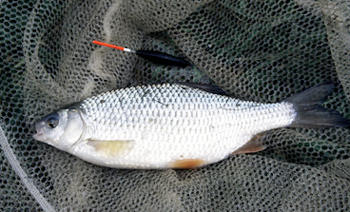
British record: 4lb 3oz. Dorset Stour, October 1990. Any fish over 2lb is considered a specimen and a 3lb’er - a fish of a lifetime.
Our most common fish,
the roach is a favourite with many anglers, from specimen hunters chasing
large solitary fish to the ‘bits’ which grace every beginner’s
net, the appeal of this species is universal.
It is the ideal beginners fish generally found living in shoals, feeding
in all kinds of conditions, at all levels, in both summer and winter.
Like all fish, roach love underwater structures, tree roots, weed beds
etc., anything which gives them a sense of security from preditors.
Baits
Popular baits are maggot, castors, small redworms and bread; either punch,
flake or paste. Other alternatives are hempseed, tares, stewed wheat,
sweetcorn (in all its varieties and flavours), bloodworm, pellets and
mini-boilies
Whenever possible I add a little flavour to the maggots, it gives them
an extra attraction, simple basic flavours, cream, vanilla, caramel, etc.,
all work and don’t cost a fortune.
Tactics for catching roach vary from venue to venue, and can also vary
from day to day, so picking the right method is trial and error, but some
basic methods work wherever you fish.
The roach is an opportunist fish that will feed in all layers of the water,
competing with its fellow shoal members for any loose bait thrown at them.
So a little and often approach - with a few maggots or casters every cast,
increases the chance of a hook-up.
Being finicky feeders the terminal tackle should be as fine as possible.
Use size 20 and 22+ fine wire hooks with maggots and casters, making sure
to bury the hook totally inside the the caster - don’t worry - the
hook always pulls through the shell.
The darker the caster is, the more bouyant it becomes, so use this to
your advantage by picking a 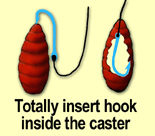 darker
caster to balance out the weight of the hook - making the hooked caster
fall through the water at the same rate as any free samples.
darker
caster to balance out the weight of the hook - making the hooked caster
fall through the water at the same rate as any free samples.
Unfortunatley roach are experts at stealing casters and leaving you with
a empty half shell, but eventually they make a mistake...
Pole fishing is an ideal method to catch them, the presentation and accuracy
being second to none.
Tiny hooks with a well-balanced rig and a trickle of bait every cast will
soon pick up fish.
Cupping out a little groundbait, suitabled flavoured, will hold the shoal
whilst not feeding them off.
A fine cloudbait on still waters is worth a try, mixed with your favourite
flavour or 50-50 with one of the specialist groundbaits.
The addition of crushed hempseed will add a little fizz as it spreads
through the water levels.
Before the immense popularity of the pole, the waggler and stick float
did the business.
A waggler with all
the shot directly under the float allows the bait to fall gently through
the water and if accompanied with constant loose feed, fish will soon
come up in the water to intercept the bait.
Various shotting patterns should be tried, but remember to keep it well
balanced to avoid tangles and to present the bait as naturally as possible.
A small piece of bread (about the size of a 5p coin) squeezed around a
size 14 hook often tempts the larger fish, don’t squeeze the bread
onto the hook too hard, because you want little bits to flake off to tempt
the fish.
If you retrieve your float and the bread is still on the hook, you’ve
overdone the squeezing!
Try using a dibber float (see tips and techniques) with a single dark
caster on a 22 hook fished about 2-3ft deep to catch fish that are near
the surface.
Cast well over the shoal, catapult in a few free samples, and then retrieve
the float into the middle of the freebies - you’ve got to be quick
- but its great sport!
Using a swimfeeder (see tips and techniques) with a mix of groundbait
and hook-bait samples, cast repeatedly into the same area is another good
method and can pick out the bigger fish.
Use the lightest quiver tip possible for the conditions, because the bites
may only be indicated by a slight knock or tremble until the fish gain
confidence.
Specimen hunters also use the ‘Method’ feeder, in a scaled-down
version, to great success, again its trial and error.
And finally to totally contradict the ultra-fine tackle approach, I managed
to bag half a dozen 1lb+ roach from the hard-fishing Hardwick lake, using
a size 8 heavy-duty carp hook crammed with as many maggots as possible
and fished on 12lb braid to a 2oz bolt rig!
The fish were seriously out-gunned, but it livened up a poor mornings
carp fishing - and it gave me something to think about!
Return to Return
to 'Catch more-----'