Fishing UK Specialist Angler & Angling Writer, Andrew Kennedy | Pike Perch Barbel Carp Lure Coarse British angler writing about fishing and specialist angling

Surface fishing for carp with floating baits is one of the most rewarding and exciting means of fishing for any species in the UK. The sight of a dark shadow emerging from the depths below, followed by a set of rubbery lips surrounding your bait really sets the pulse racing!
Fishing on the surface can be done at distance using a surface controller float, but I prefer to fish within a few rod-lengths of the bank and either freeline baits, or use the minimum casting weight I can get away with.
One problem with free-lining is that it is usually fished with the mainline straight through to the hook, which is okay in clear swims, but in snaggier areas a lower-breaking strain hooklength is advisable as a safety measure.
Using a hooklength has another benefit in allowing the use of a less visible line leading to the hook. For surface hooklengths I prefer either a fluorocarbon or one of the many low-diameter, high-tech lines currently available, because I feel these reduce the chance of spooking fish.
To prevent the swivel sinking and to give me additional casting weight, I use brightly coloured floating putty, sold as a strike indicator for fly fishing. This putty is extremely versatile and can be moulded to any shape. It’s extremely buoyant, and if required, split shot can be moulded inside the putty, when you need to cast an extra few feet. The fluorescent colour of the putty allows you to maintain visual contact with the rig even in low light, yet it doesn’t spook carp. I very often have fish go for the putty before they go anywhere near the bait! The putty lands on the surface with a delicate “plop”, compared to some controllers which land with an enormous splash.
For an extremely versatile surface rig, I like to use a run-ring and snap-link pushed onto a swivel-guard bead. This allows me to either mould a lump of putty around the snap-link for close range work, or remove the putty and clip on a controller if the fish move further out. It takes seconds to change, and allows me to keep in contact with groups of feeding fish, no matter where they decide to feed.

When arriving at a swim, I find that by firing a few baits out to start with, you can judge how the carp are feeding and adjust your approach to suit the situation. For instance, if fish are only taking the odd one of your initial free offerings, they are probably being taken by passing fish which aren’t particularly bothered about feeding – they simply can’t resist an easy meal.
At times like this it can often be best to cast out straight away and keep loosefeed to a minimum. This way you have more chance of these opportunistic fish taking your bait instead of being spoiled for choice by hundreds of freebies. But if several fish start taking baits it’s advisable to keep bait going in, little and often, to build up confidence in the fish before you introduce a hookbait. Remember, feeding on the surface is a risky business for any fish, so initially most carp will feed cautiously, but will gradually lose this caution with each free offering they take.
Early mornings and evenings are usually the best times for surface fishing, but it can be done at night if you listen for feeding fish and either feel the line for bites or set up your rod on a bite alarm and lightweight bobbin. As with most methods of fishing, the middle of the day is usually the least productive time.
I recently fished a local park lake – Sutton Lawn Dam – which I had not fished for about 7 years. It is now a superbly run fishery which has received a lot of new stock since the fishing was taken over by Ashfield AA.
There are now carp to over 20lb, including several double-figure grass carp approaching 20lb. Besides carp there are tench to over 7lb, as well as crucian carp, bream, the odd pike and plenty of roach, rudd & perch. For more information on fishing Sutton Lawn Dam, please visit https://m.facebook.com/ashfieldangling.assocation
I was in luck on the evening I decided to visit, because as the sun started to set, the carp started to feed on the surface. They didn’t just feed – they took every free offering I threw at them and it wasn’t long before my imitation dog biscuit was taken by a hard-fighting common carp of exactly 13 pounds.

Over the next hour I added two mirror carp of 12lb 4oz and 10lb.
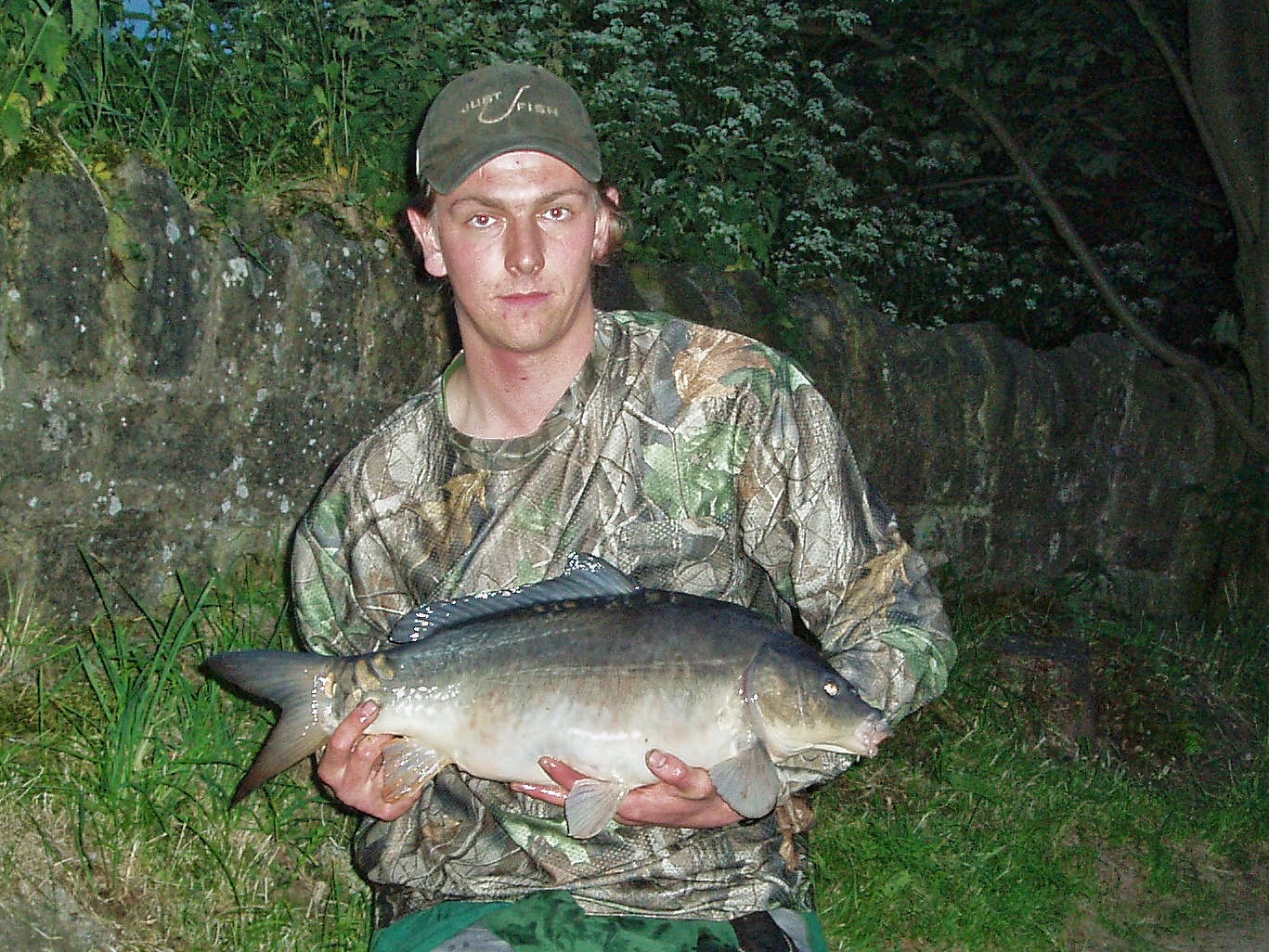

As the light faded I threw out a couple of full slices of bread in the margins. I then fished a piece of breadcrust close to a slice and listened for the “slurps”.
One such slurp resulted in the line being pulled from my fingers as the water exploded in front of me, thanks to an extremely powerful fish. I had already decided this cast would be my last, so as the fish tore line from my reel, I just had to turn on my headlamp, to catch a glimpse of just what I was connected to. As the fish rolled on the surface, I caught a flash of a dorsal fin in the torchlight. Instantly I knew what I was battling – a personal best grass carp!

As usual when I realise I’ve hooked something special, my legs went to jelly and I nervously tried to net the fish 5 times, before the grass carp finally succumbed and rolled over the net. At 12lb 4oz, this was a great fish – and what a fight! The perfect climax to a hectic couple of hours’ surface fishing, and proof if needed, that the rewards are out there for the surface angler.
That’s if the sight of big carp feeding on the surface isn’t reward enough!
Good fishing to you all