Angling Star Articles, Articles, Just-Fish Content, Legering & Swimfeeder Fishing Articles, Notable Captures & PBs, Rig Advice, Roach & Rudd, Session Reports, Stillwater Fishing Articles, Technique, Tips & Advice
4,818

Roach fishing is something I very seldom do, in fact I cannot remember the last time I set out to specifically catch roach, except maybe to use as pike baits! Unsurprisingly, my roach PB has never been anything to shout about; I don’t know exactly what my biggest roach was, but it was certainly below 1lb. The positive of this was that there’s a lot of room left for improvement! Through the grapevine I heard of a local day ticket water which had produced a few large roach to pleasure anglers over the summer months. It was time to try for my first big roach and this seemed the perfect place to start. I remembered reading an article last year about the virtues of flavouring maggots with super-sweet flavours such as scopex, in helping to tempt winter roach to feed. So I got hold of some strong scopex bait spray and sprayed this onto my maggots, twice a day, for two days prior to the session. The smell was unbelievable! Despite being sealed in a large bucket inside the shed, you could smell scopex in the garden with the shed door shut! I met up with my good friend Kevin …
Read More »
DIY Tackle, Tips & Hacks, Just-Fish Content, Rig Advice, Technique, Tips & Advice
6,286

There are two main, commonly practised methods of making wire traces for pike fishing. The first is a method called “twisting” or “twiddling“. Whilst some anglers swear by this technique, I find it to be unnecessarily fiddly, untidy and unreliable. The other common method is called “crimping“, which is the method I shall describe here. Whilst no hooklength can ever be 100% reliable, I have refined my crimping techniques over the years and nowadays it is very, very rare that one of my home-made pike traces lets me down. Remember, if you’re unsure about tying your own traces, or you don’t have the time or patience, many of the big manufacturers sell ready-tied traces which are good value. The bonus with making your own is that you can customise them to suit your bait size, hook size, rigs, conditions, etc. Plus, if one of your traces becomes unusable through kinking or other damage, you can re-use expensive components such as hooks and swivels. Remember – whether you buy traces or make your own, never fish with a damaged wire trace. A kinked trace will snap under far less pressure than a perfect trace will. Always carry spares ready-tied in a …
Read More »
AnglersToday Articles, Angling Star Articles, Articles, Catfish, DIY Tackle, Tips & Hacks, Fishing Venue Information, Just-Fish Content, Legering & Swimfeeder Fishing Articles, Notable Captures & PBs, Predator Fishing Articles, Rig Advice, Session Reports, Stillwater Fishing Articles, Technique, Tips & Advice
7,649
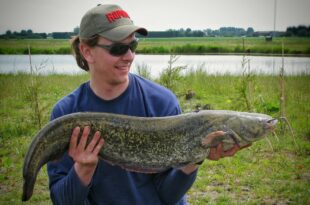
Catfish are amongst the most difficult fish to target in the UK. Certainly in the East Midlands, not many fisheries are licensed to stock them and they can be sporadic feeders with a tendency to feed primarily after dark, and predominantly when the water is warm . Add to this the species’ abrasive pads lining the mouth and throat, along with a reputation as a strong fighter, and you have a highly prized and very worthy adversary. My previous two outings targeting catfish – both night sessions at Willowbank Fishery and Shatterford Lakes – had yielded me nothing. So when I saw a report on the Anglers Today website – detailing an unbelievable capture of 810lb of catfish and carp in a 48 hour session from Willowcroft Fisheries, near Wisbech in Cambridgeshire – I was more than a little intrigued! Upon contacting the fishery, I was pleasantly surprised by the friendliness of the staff, who duly answered my (many!) questions about the fishery, its fish, its recent form, etc. As luck had it, the cats were feeding well following a recent warm spell, so a date was arranged. Accompanied by Craig Croft-Rayner I made the trek down to Wisbech for …
Read More »
AnglersToday Articles, Angling Star Articles, Articles, Barbel, Chub, Just-Fish Content, Legering & Swimfeeder Fishing Articles, Rig Advice, River Fishing Articles, Session Reports, Technique, Tips & Advice
987

By mid-August, I am usually well into my stride catching river fish, especially barbel. This year, however, I’ve struggled to even get a bite! The problem with becoming confident in certain methods, baits and even venues, is that it’s easy to become set in your ways with your approach. The old adage “If it aint broke, don’t fix it” springs to mind. But what happens when it is broke, and your tried and trusted methods fail you time and again? It’s so easy to dwell on glories past, sticking with the same setup in the hope that it will work eventually. The truth is, conditions change, swims change, fish can become wary of certain rigs and baits. If you find yourself struggling, you must start ringing the changes until you find something else that works. Two chance meetings earlier in the month inspired me to get out of my recent rut, and I’m so relieved! With very few bites, and a single measly 10 ounce chub to show for several after-work river sessions, I knew I had to change something. My initial focus, along with trying a variety of different swims, was to change my baits until I found one …
Read More »
AnglersToday Articles, Angling Star Articles, Articles, Bream, Carp, DIY Tackle, Tips & Hacks, Float Fishing Articles, Just-Fish Content, Rig Advice, Session Reports, Stillwater Fishing Articles, Technique, Tench, Tips & Advice
8,703

Late Spring, into Summer is the perfect time of year to target tench, carp, crucians and bream in stillwaters. This gives me an excuse to use one of my favourite techniques – the humble “Lift Method”. Forget fancy anti-eject combi-rigs and the like; the lift method is simplicity itself. All the terminal tackle you need is a float, a hook, a swivel and some swan shot. The principle of the lift method is to over-shot your float and fish with all of the weight laid on the bottom. The float is set slightly over depth, so that when the rod is set up on rests, the float can be made to sit upright by simply tightening the line, so you can finely adjust how much float tip is visible. When a fish takes your bait, the shot is often lifted from the lake bed, which causes your float to lift out of the water, sometimes even laying horizontal on the surface! It is this action from where the method derives its name. Very often, however, you’ll notice knocks on the float tip before it disappears, just as you would with a waggler. Either of these bite indications are positive enough …
Read More »
 Fishing UK Specialist Angler & Angling Writer, Andrew Kennedy | Pike Perch Barbel Carp Lure Coarse British angler writing about fishing and specialist angling