Blog Posts, DIY Tackle, Tips & Hacks, Just-Fish Content, Technique, Tips & Advice
4,859

Isotopes (also known as betalites, betalights and Starlites/starlights) are an essential item of tackle for night fishing when watching the rod tip for bite indication is required. To attach these to the tips of your rods you’ll need some kind of adapter, or something to attach them to. There are a few products on the market which offer a temporary, removable solution – such as the Korum Starlight & Isotope Holder Kit, Enterprise Tackle’s Avon/Barbel Rod Tip Nightlight Adapter & Quivertip Nightlight Adapter and the Drennan Isotope Kit – but if, like me, you do a lot of fishing in the dark, a permanent holder is a far superior option. If you have the money for a custom-built rod, several rod builders allow you to specify a night light adapter. But if, like most of us, you’re using off-the-shelf rods or if you’d like to retrofit an adapter to your older rods, you can achieve the same thing with a little bit of DIY. I’ve come up with a solution, which I’ve added to several of my barbel rods, zander rods and quivertip rods over the past couple of seasons (they will work for any rods where you may need …
Read More »
Just-Fish Content, Technique, Tips & Advice, Videos
3,294

An instructional video describing the method required to convert Pro-Logic quick-change bankstick adapters (used with fishing rod rest heads, bite alarms, rod pods, etc.) to make them universal-fit. This makes the old and new versions of these very useful adapters fit each other. Frustratingly, Prologic have changed the design of their quick release adapters very slightly over the years. To my knowledge there have been 3 versions: mk1, mk2 & mk3. The male part of the mk2 adapters will fit into all 3 female designs but the mk1 & mk3 male parts will not fit into the mk2 female parts, which were spring-loaded to pop out the male part on release. The mk3 (left) and mk2 (right) versions of the Prologic quick change bankstick adapters. Note the difference in shape on the male parts in the centre of the pic. I have these adapters fitted to all my bank sticks, bite alarms, rod rest heads, etc. and I have all 3 designs. I find them really useful and surprisingly reliable. My only bugbear with them over the years has been the backward compatibility of new versions. It would be expensive to replace all of my adpaters when a new design …
Read More »
DIY Tackle, Tips & Hacks, Just-Fish Content, Rig Advice, Technique, Tips & Advice
4,445

It’s often good practice when predator fishing to keep your mainline up and off the deck, to avoid bottom debris (especially around autumn time when there are lots of fallen leaves & twigs) and ensure a truly low-resistance presentation. Many anglers achieve this through the use of pop-up/buoyant leger stems to attach their leads when deadbaiting. Buoyant run rings and pop-up leger stems might also be useful in carp fishing and other specialist angling. For example, a floating run ring could be the perfect way of attaching a surface controller float when floater fishing for carp; whilst a buoyant leger stem could be used an alternative to a sunk float – to allow a running lead rig to be used over weed (instead of a fixed lead on a chod rig, for example). Buoyant leger attachments have been on the market for years, most notably in the form of Middy’s Buoyant Leger and Fox Leger Stems. Annoyingly, the Middy ones have become difficult to find and the Fox ones tend to just fall apart! They’re way too fragile for me to use with any confidence, so I started modifying them. Then I thought, instead of paying so much for a …
Read More »
DIY Tackle, Tips & Hacks, Just-Fish Content, Rig Advice, Technique, Tips & Advice
6,288

There are two main, commonly practised methods of making wire traces for pike fishing. The first is a method called “twisting” or “twiddling“. Whilst some anglers swear by this technique, I find it to be unnecessarily fiddly, untidy and unreliable. The other common method is called “crimping“, which is the method I shall describe here. Whilst no hooklength can ever be 100% reliable, I have refined my crimping techniques over the years and nowadays it is very, very rare that one of my home-made pike traces lets me down. Remember, if you’re unsure about tying your own traces, or you don’t have the time or patience, many of the big manufacturers sell ready-tied traces which are good value. The bonus with making your own is that you can customise them to suit your bait size, hook size, rigs, conditions, etc. Plus, if one of your traces becomes unusable through kinking or other damage, you can re-use expensive components such as hooks and swivels. Remember – whether you buy traces or make your own, never fish with a damaged wire trace. A kinked trace will snap under far less pressure than a perfect trace will. Always carry spares ready-tied in a …
Read More »
AnglersToday Articles, Articles, Barbel, Chub, DIY Tackle, Tips & Hacks, Just-Fish Content, Legering & Swimfeeder Fishing Articles, Notable Captures & PBs, River Fishing Articles, Session Reports, Technique, Tips & Advice
13,532
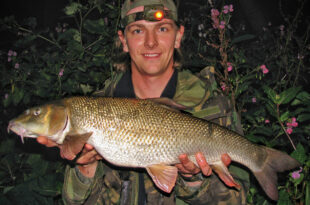
With the fluctuating river levels and a generally unreliable Summer once again, I found that river sport started fairy slowly and has been very inconsistent since. I have been experimenting with new venues and stretches of river I hadn’t fished before and, despite my catch rates being disappointing, I’ve learnt about features I didn’t know existed and found some promising areas which I’m sure will come into their own during the colder months. One evening, I even spotted a shoal of around 20 good barbel moving in very shallow water, but seemingly not feeding. Opting to take the “fish where the fish are” approach, I stealthily crept up to the river and cast a lobworm a little upstream of three individuals I could see. They did not appear to be spooked by the bait entering the water, so I slowly backed away from the skyline, and touch-legered expectantly for a good half-hour, without a nibble. As darkness approached I put out a second rod and opted for more conventional barbel tactics using pellets and boilies, but still no success! It had been quite a spectacle and privilege to watch these fish in the clear rapids, but despite my best efforts …
Read More »
AnglersToday Articles, Articles, Blog Posts, Float Fishing Articles, Just-Fish Content, Legering & Swimfeeder Fishing Articles, Lure Fishing Articles, Notable Captures & PBs, Pike, Predator Fishing Articles, River Fishing Articles, Session Reports
2,902

Just recently I managed a days pike fishing on the River Trent and found the fish in a feeding frenzy! I started the day off lure fishing, using a home-made lure which had so far been my most successful home-made pattern. This time out, it wasn’t to disappoint. On my third cast, I felt the familiar ‘bump’, signalling a take from a pike. Before long, I had played my first fish of the day to the bank. Seeing that the hooks were held in a safe position, I decided to hand-land the fish, which I quickly returned. I estimated the weight at around four pounds. The new homemade lure I was using soon rewarded me for my hard work! On the very next cast, I had turned the reel handle only a couple of times when the resistance went solid. Upon striking, the rod took on a healthy bend and the fish stayed deep, signalling that I’d hooked a good fish.Because I use barbless trebles on my lures, I always keep a tight drag, which means that not many of the fish I hook on lures actually take any line during the fight. This fish, however, managed to power away …
Read More »
 Fishing UK Specialist Angler & Angling Writer, Andrew Kennedy | Pike Perch Barbel Carp Lure Coarse British angler writing about fishing and specialist angling